INCONTROL-RL: fail-safe flight control for drones, built from automotive chips
Take Off Insights 2026 · Session "UAS & Testing" · Bernhard Lutzer, TTTech Computertechnik AG
Autonomous drones need three things that rarely come together: a flight computer that never disagrees with itself, AI that can decide where to land when the link drops, and a path to regulatory approval. INCONTROL-RL tackled all three, and did it on hardware cheap enough for small series.
At a glance
| Consortium | TTTech (lead), Schiebel, JKU Linz, TU Wien (microelectronics), Austro Control |
| Runtime | October 2020 - March 2024 (36 months plus 6-month extension) |
| Budget | €2.34 million total, €1.55 million FFG funding |
| Target | Laboratory platform up to TRL 4, basis for a later miniaturised ASIC |
The problem
Small-series UAVs cannot justify custom avionics chips, so the team asked whether automotive-grade components could be made safe enough. At the same time, beyond-visual-line-of-sight operations require the "Specific" category and a SORA risk assessment, and any AI on board has to be explainable to a regulator.
What they built
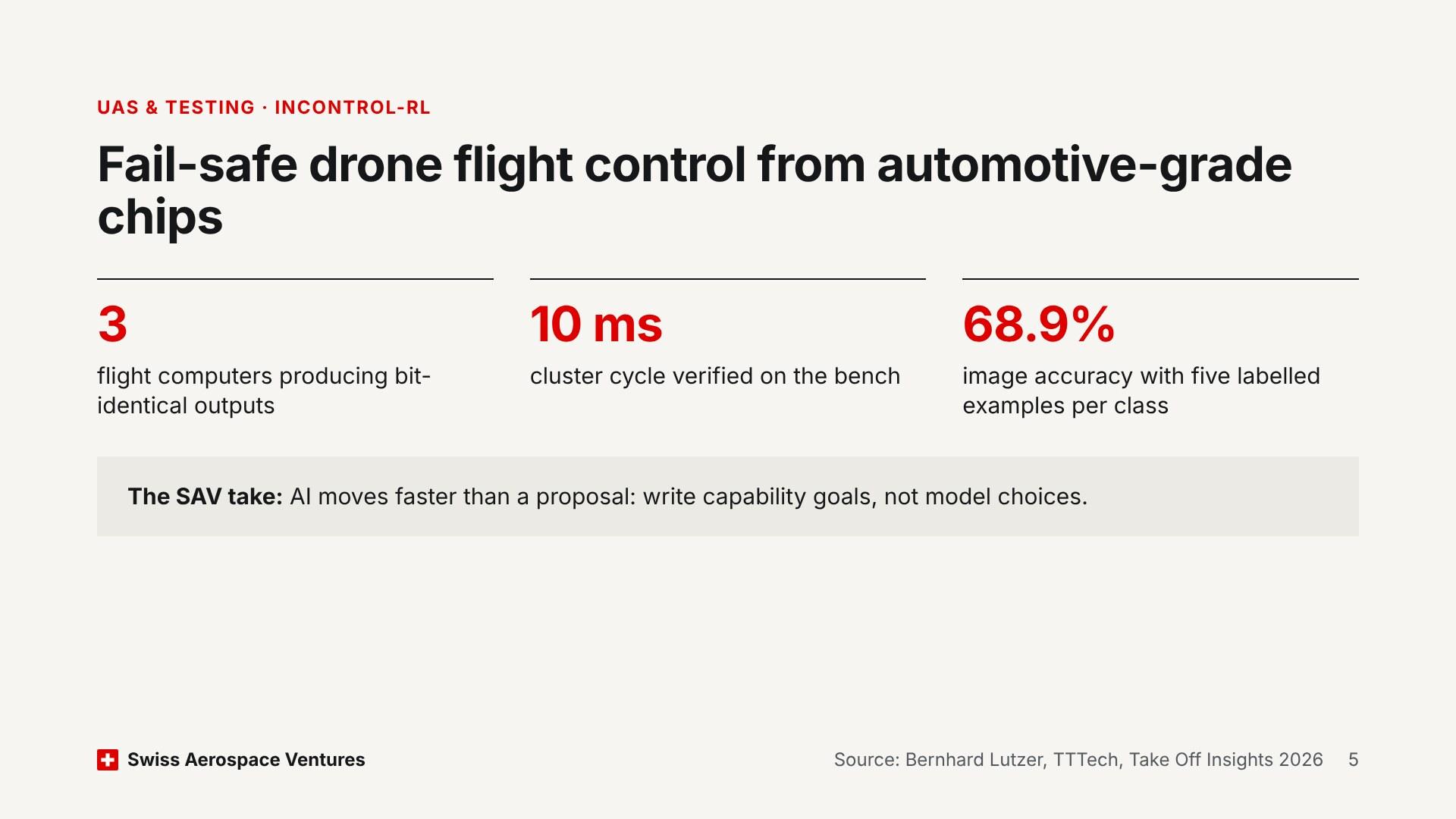
- Three flight control computers running in parallel on two independent, time-triggered TTEthernet networks, with a 10 ms cluster cycle verified on the bench.
- Replica determinism: every redundant unit produces bit-identical outputs in every iteration, across reduction, compression, calculation and transmission.
- A soft-deterministic Ethernet interface that puts standard off-the-shelf controllers onto the TTEthernet time base.
- Hardware-in-the-loop tests with Schiebel's real flight hardware (flight computer, servo actuator, engine controller) from the CAMCOPTER S-100 programme.
The AI part
JKU Linz worked on landing-zone detection. Using contrastive tuning, the team reached 68.9% ImageNet accuracy with only five labelled images per class (published at AAAI 2024). A camera-to-text model correctly described a city centre as unsafe for landing but, over farmland, described the scene without spotting the risk, because it had never been trained on aerial imagery. TU Wien measured arrays of up to 50,000 transistors in 28 nm CMOS and SiC and found that timing shifts in the picosecond-to-nanosecond range do not affect the system.
Certification and liability
Austro Control mapped the route: Open category, then Specific with SORA, and from SAIL III upwards EASA certification may apply. Liability sits with the operator first and the manufacturer second.
Lessons learned
Lutzer was refreshingly candid: AI moves faster than a proposal. Large language models and CLIP arrived mid-project, and the research plan had to adapt. Training data arrived late, which caused the extension. And certification has to be designed in from the start, not bolted on.
Back to the overview: Take Off Insights 2026
People and organisations
- Bernhard Lutzer, Speaker, TTTech Computertechnik AG
Organisations: TTTech, Schiebel, Johannes Kepler University Linz, TU Wien, Austro Control
Sources
- Talk and slides by Bernhard Lutzer, Take Off Insights 2026, Vienna, 12 November 2026