CRIAQ's playbook: how Québec turned collaborative R&D into an aerospace export machine
Take Off Insights 2026 · Keynote · Guillaume Côté, President & CEO, CRIAQ (Consortium for Research and Innovation in Aerospace in Québec)
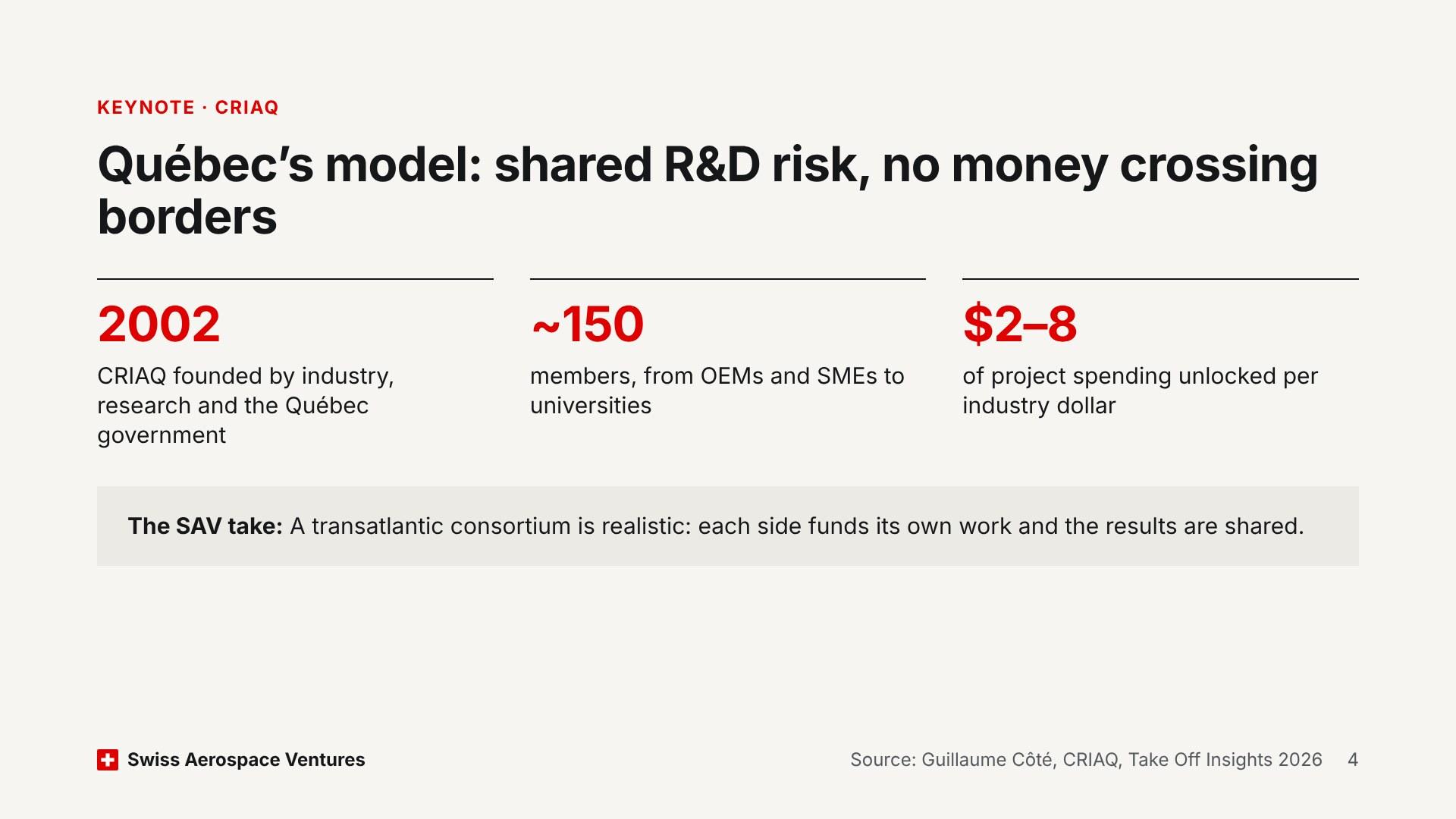
The FFG picked its keynote well. Before a full day of Austrian project results, Guillaume Côté showed the room what a mature collaborative research system looks like when it has been running for more than two decades.
At a glance
| Organisation | CRIAQ, created in 2002 as a partnership of companies, research institutions and the Québec government |
| Members | Around 150, from Airbus, Bell, Bombardier, CAE and Pratt & Whitney Canada to SMEs, universities and technology transfer centres |
| Coverage | TRL 1 to 6: "exploring" and "maturing" innovation |
| Mission | De-risk R&D through funding and collaboration, and keep Québec aerospace competitive |
Why Québec bothers
The numbers on Côté's slides explain the urgency. Québec's aerospace sector generates about CAD 22 billion in sales, exports more than 85% of what it produces and hosts roughly three quarters of Canada's aerospace R&D. Montréal is also home to ICAO, IATA and ACI. A cluster that exports almost everything cannot afford slow innovation, so the province built a machine to share the risk.
How a CRIAQ project is built
The structure is deliberately simple:
- The problem comes from industry. At least one company and one research organisation, typically for two to three years.
- TRL 2 to 6. CRIAQ sits in the gap between academic research and product development.
- Shared funding. CRIAQ (provincial money) covers 20-40%, federal co-funders up to 40%, industry 20-40%. CRIAQ's own contribution can reach CAD 1.5 million per project.
- Leverage. Every dollar from industry unlocks two to eight dollars of project spending.
The international framework, and why it matters for Austria
CRIAQ has already run projects with France, the USA, Germany, Austria and Italy. The rules are pragmatic: at least one company and one research partner on each side, similar project size on both sides (within about 30%), and no money crossing borders. Each side signs its own regional funding agreement, and the partners sign one international project agreement on top. Projects can be tightly or loosely integrated.
Côté's showcase was LiBio, a lightweight bionic aircraft interior developed by a Canadian-German-Austrian consortium including Bombardier, Queen's University, ZAL, Fraunhofer IFAM, Joanneum Research and Austrian SMEs such as Rembrandtin, Inocon and F.List, funded on the Austrian side by the FFG. The demonstrator is a topology-optimised business-jet interior: a 3D-printed polymer frame with printed metal inserts and integrated speakers, power, display and surface coating.
Where Côté sees common ground
He named four research areas of shared interest: sustainability (bio-sourced and recycled materials, circularity, lightweight additive manufacturing), robotics and automation (automated inspection, human-robot collaboration), drones and unmanned systems (long range, harsh-environment testing, hydrogen and battery propulsion, counter-UAS) and space (Earth observation, PNT, light launch, materials). Almost every topic maps onto something presented later that day in Vienna.
Context
CRIAQ keeps building bridges across the Atlantic. It has renewed its research partnership with Hamburg's ZAL Center of Applied Aeronautical Research through a memorandum of understanding, and Québec's innovation zone Espace Aéro signed a cooperation agreement with the Mila AI institute in 2026 to connect aerospace with artificial intelligence. The CRIAQ International programme, which gives Québec SMEs an extra incentive to join international projects, ran its latest intake in autumn 2026.
Back to the overview: Take Off Insights 2026: what Austria's aviation research is really telling founders
People and organisations
- Guillaume Côté, President & CEO, speaker, CRIAQ
Organisations: CRIAQ, FFG - Austrian Research Promotion Agency
Sources
- Talk and slides by Guillaume Côté, Take Off Insights 2026, Vienna, 12 November 2026
- ZAL and CRIAQ renew research partnership (Airframer)
- 2026 International Aerospace Innovation Forum (Aéro Montréal)
- CRIAQ International programme (hellodarwin)