Take Off Insights 2026: what Austria's aviation research is really telling founders
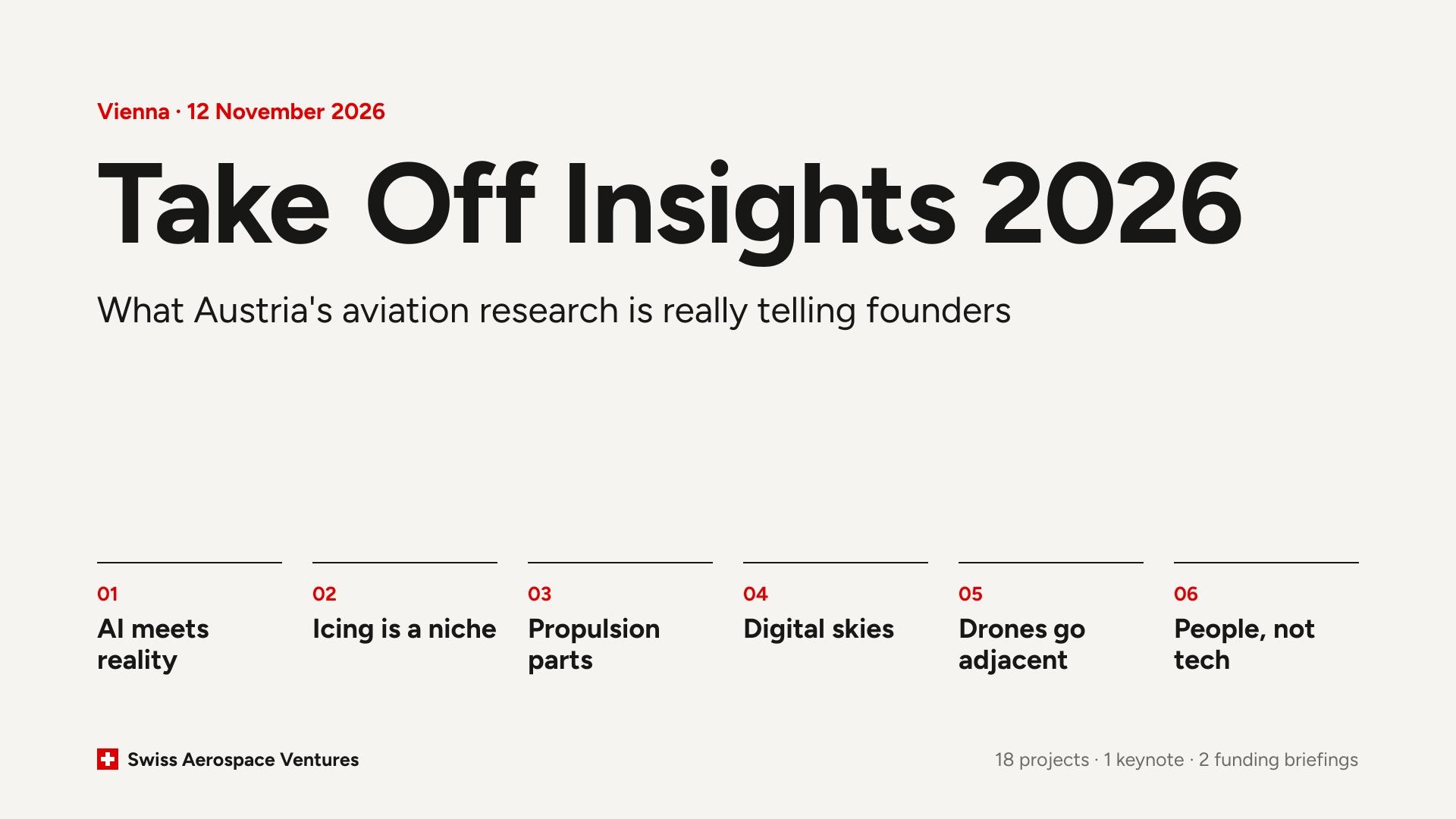
On 12 November 2026, the Austrian Research Promotion Agency (FFG) and the Federal Ministry for Innovation, Mobility and Infrastructure (BMIMI) gathered Austria's aviation research community at Radetzkystraße 2 in Vienna. The format is simple and unusually useful: completed projects from the Take Off programme present what they set out to do, what actually worked and where the results are going next. Eighteen projects, a keynote from Québec and two funding briefings in a single day.
We were in the room. Below is our recap of the themes that cut across the day, with a link to a dedicated article for every presentation. Our lens, as always, is the founder's: where is the technology going, who is buying, and what does it take to turn research into a company?
The day at a glance
| Date / venue | 12 November 2026, BMIMI, Vienna |
| Hosts | FFG on behalf of BMIMI; moderated by Vera Eichberger (FFG) |
| Opening / closing | Karin Tausz, CEO of the FFG / Sophie Hoffmann, BMIMI |
| Keynote | Guillaume Côté, President & CEO, CRIAQ (Québec) |
| Sessions | UAS & Testing · AI, Cyber & Operations · Funding Insights · Safety, Training & ATM · Propulsion, UAM & Materials |
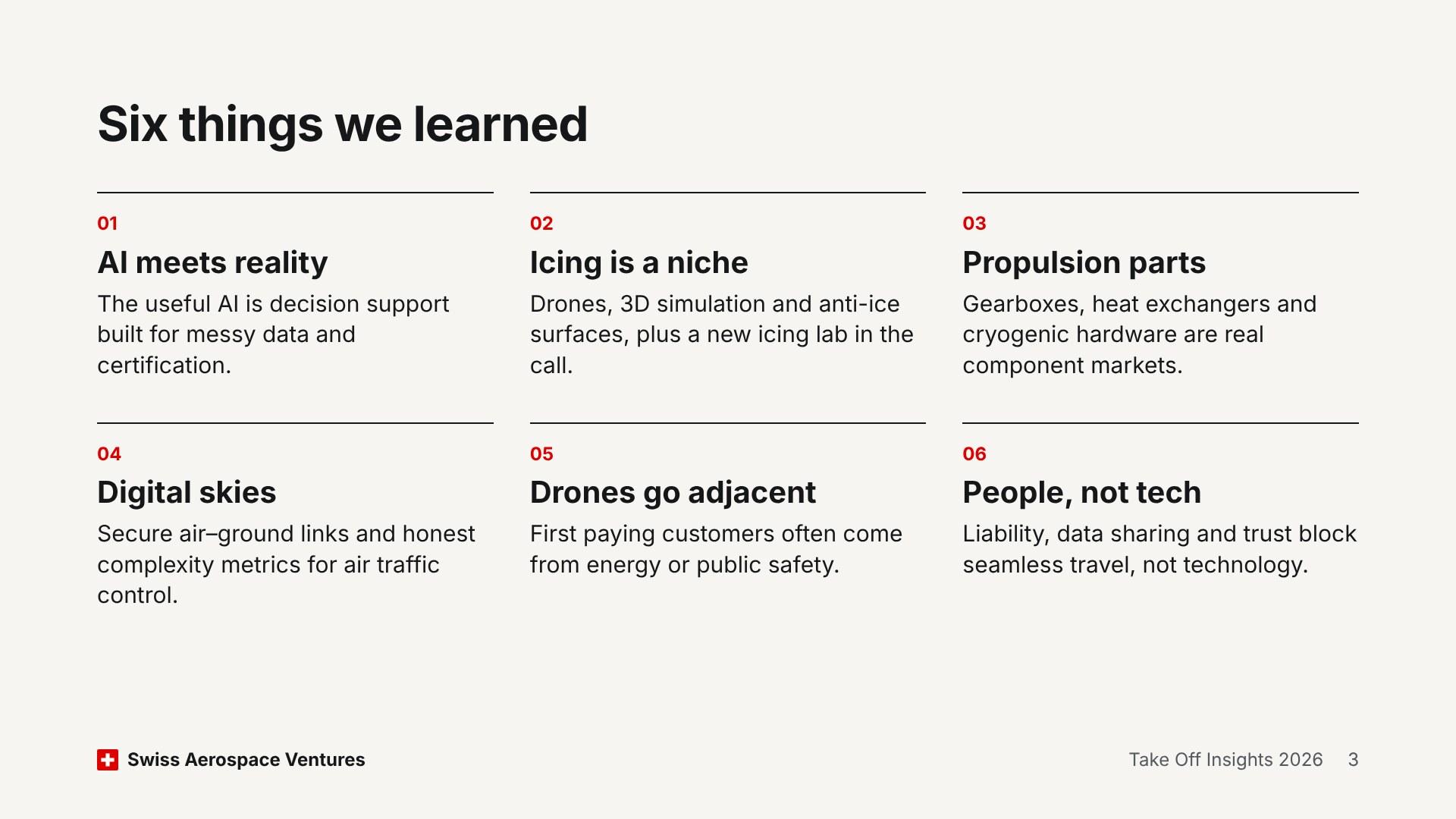
1. AI is everywhere. The hard part is reality.
Almost every project had an AI component, and the most valuable insights were about its limits.
Robimo and Austro Control trained a reinforcement-learning controller on real Vienna traffic and found that a "perfect" approach plan falls apart after a few seconds of pilot reaction time. The product became a complexity metric for human planners, not an autonomous controller (WeCAP TMA, coming on 26 Nov). Frequentis showed that remote-tower vision models that work at one airport fail at the next, and used foundation models as automatic annotators to adapt without manual labels, cutting false positives by about 80% (SAFER, coming on 28 Nov). TTTech's team admitted that "AI moves faster than a proposal": LLMs and CLIP arrived mid-project (INCONTROL-RL, coming on 17 Nov).
A recurring pattern: expensive physics simulation, then fast surrogate model, then AI agent, then physical validation. It underpins TU Graz's turbine-duct design tools (ARIADNE, coming on 22 Nov) and Alpex's robotic carbon-fibre draping (JARVIS4Pre, coming on 20 Nov). Elsewhere, AI is becoming a sensor: Combustion Bay One's autoencoder predicts a flashback about four seconds before it happens (crystAIr, coming on 1 Dec), and Research Studios Austria uses eye tracking and procedure detection to make pilot assessment objective (EmPACT, coming on 27 Nov).
Founder takeaway: in safety-critical aviation, AI sells first as decision support and evidence generation. Design for certification and messy real-world data from day one.
2. Icing is Austria's quiet superpower
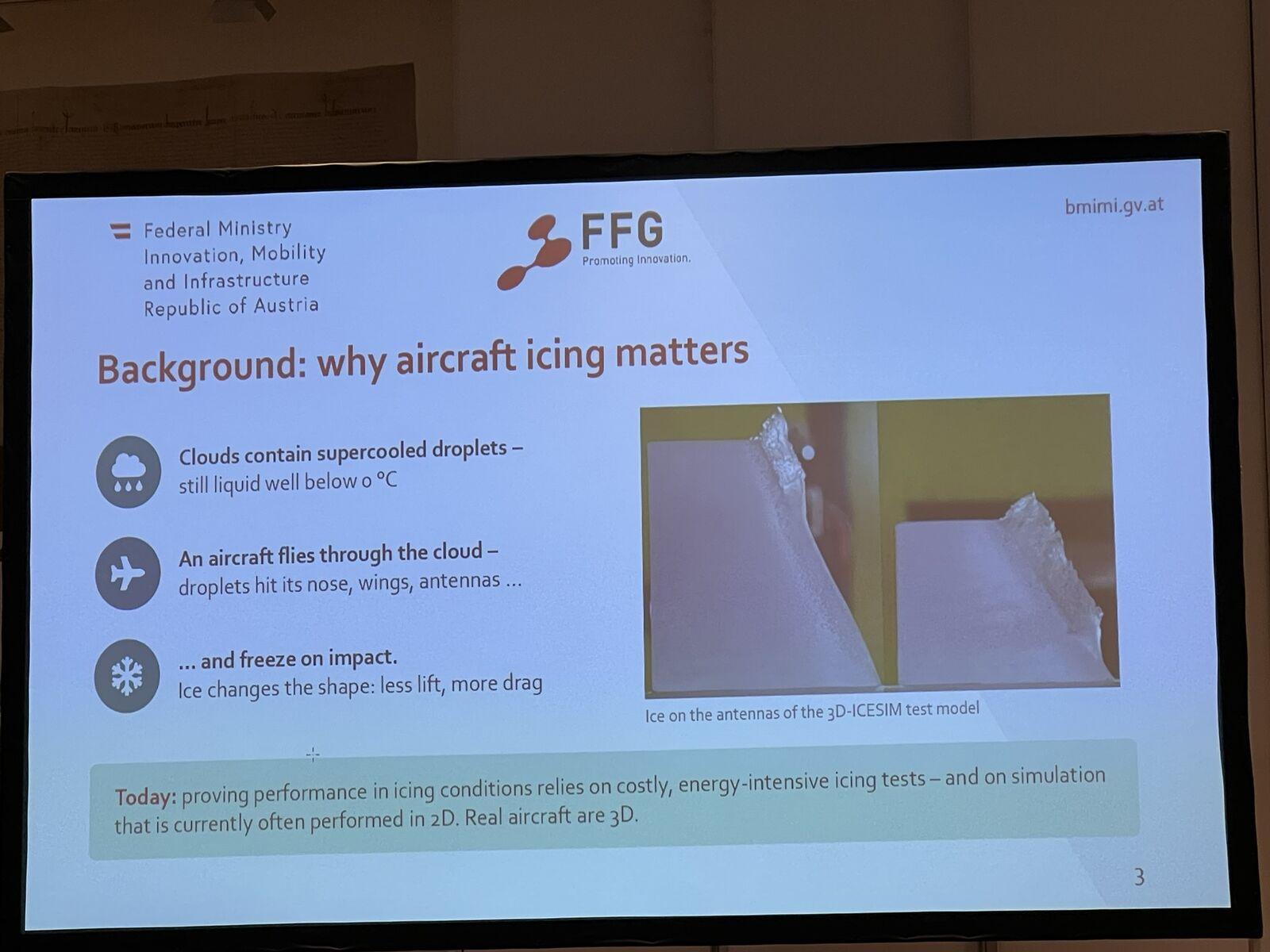
Three projects, one ecosystem. AIIS showed that in-flight icing degrades a multicopter within minutes, and that a low-power, fluid-based protection system works; it is now heading for market approval in IceDrone 2 (All-weather Drone, coming on 18 Nov). FH JOANNEUM, RTA, AeroTex and AIIS built a unique 3D icing dataset with new measurement methods, and follow-ups already include work with NASA (3D-ICESIM, coming on 29 Nov). TU Wien used femtosecond lasers to create surfaces that shed ice (LABELO, coming on 30 Nov).
The FFG has noticed: the 2026 Take Off call includes a dedicated Economic Innovation Laboratory on icing. New configurations, from drones and eVTOLs to open rotors, all need fresh icing evidence. That is a services market, and Austria has the full stack within a few hours' drive.
3. Propulsion: from the gearbox to the hydrogen tank
ADT, AIT and LKR studied a motor-generator inside the fan gearbox of an A320neo-class geared turbofan; the best variant saved 14.5% fuel on short missions, and a freedom-to-operate check led to contact with Rolls-Royce (DiMiTe, coming on 24 Nov). TU Wien mapped the next evolutionary and revolutionary steps for geared turbofans, including heat exchangers that turn gearbox waste heat into thrust (GREEN-by-GEARS, coming on 3 Dec). TEST-FUCHS built the liquid hydrogen test platform that now feeds Clean Aviation projects and a national LH2 tank lighthouse project (LHYTAMAN, coming on 4 Dec).
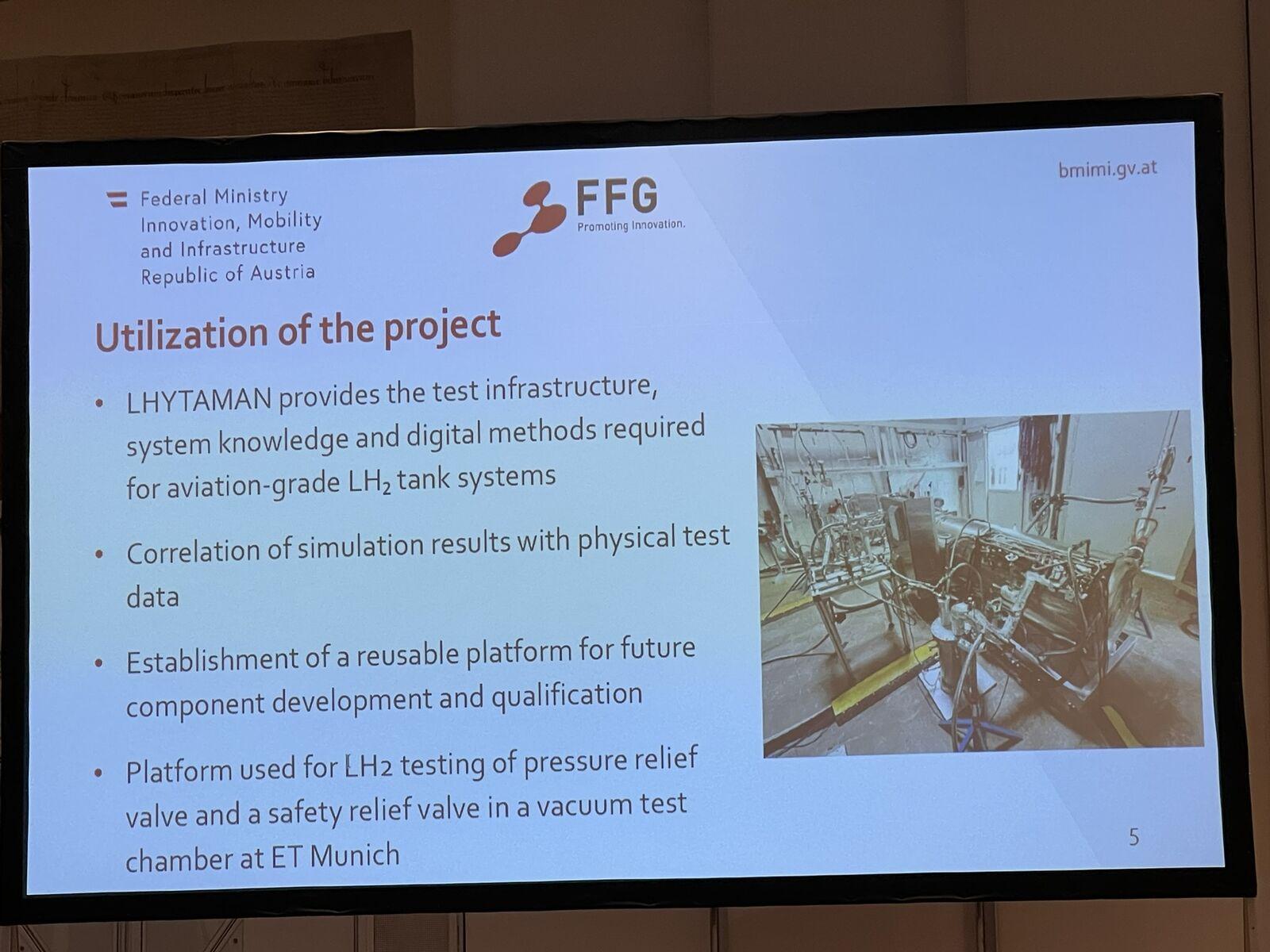
Founder takeaway: you don't need to build an engine to play in propulsion. Gearbox components, thermal management, cryogenic valves and sensors, and test services are all real component-level markets.
4. Digital skies need secure links and honest metrics
The successor to analogue VHF is LDACS, a broadband air-ground data link. FH JOANNEUM, Frequentis and SITA, twinned with Rohde & Schwarz, DLR and DFS in Germany, built its security and mobility concept and an interoperable reference implementation, now used in SESAR 3 (CyMoDACs, coming on 23 Nov). Together with SAFER and WeCAP, it shows the depth Austria has in CNS/ATM, anchored by Frequentis and Austro Control.
5. Drones are finding customers outside aviation
TTTech, Schiebel and partners built a triple-redundant, bit-identical flight control platform from automotive-grade chips (INCONTROL-RL, coming on 17 Nov). RECENDT put a laser ultrasound probe on a 25 kg tethered drone to find hidden damage in composite airframes. After presenting in Nanjing, they ended up in a development project with an oil and gas multinational (LAUDENT, coming on 19 Nov).
Founder takeaway: the first paying customer for aerospace technology is often in energy, infrastructure or public safety. Build the aviation case for credibility; let an adjacent market fund the next TRL steps.
6. The passenger problem is a business-model problem
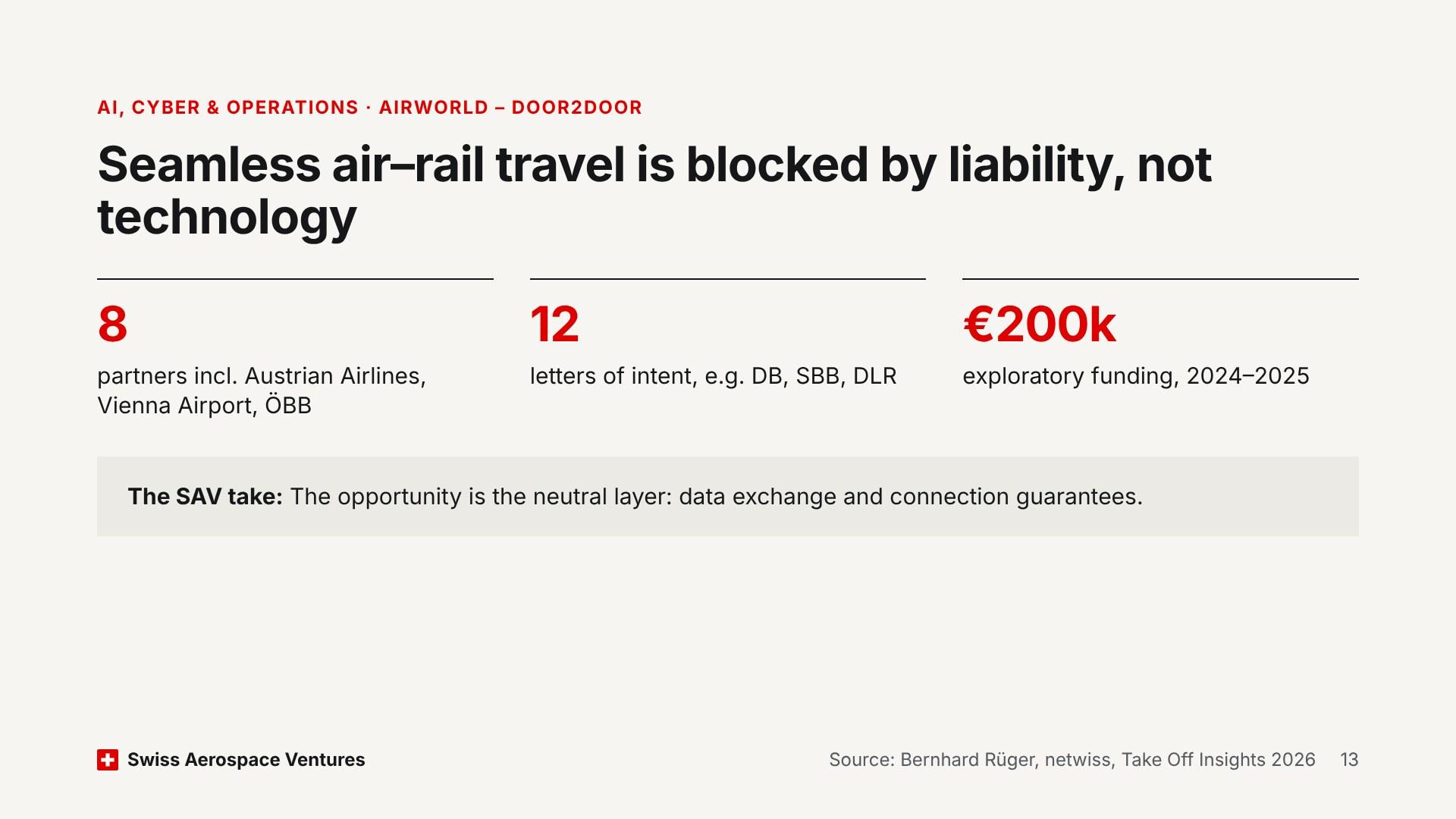
netwiss, Austrian Airlines, Vienna Airport and ÖBB designed a smart luggage rack and a rail-air connection guarantee, then concluded that the bottleneck is not technology but liability and data sharing between operators (AirWorld - Door2Door, coming on 25 Nov). AIT used VR flights and a virtual Vienna vertiport to study what it takes for passengers to trust automated air taxis (im.FLUGE, coming on 2 Dec).
And on the factory floor: TU Wien, MCL, voestalpine BÖHLER Aerospace and ModuleWorks cut distortion in milled titanium parts by 60% (AeroDOM, coming on 21 Nov).
The model behind it all: collaboration that de-risks
Guillaume Côté's keynote set the frame. CRIAQ has run collaborative aerospace R&D in Québec since 2002: industry brings the problem, funding is shared between province, federal co-funders and companies, and every industry dollar unlocks two to eight dollars of project spending. Its international framework lets partners in different countries run a joint project without any money crossing borders, and it has already been used with Austria in the LiBio aircraft interior project (read the keynote article, coming on 16 Nov).
Follow the money: what's open now
Take Off Call 2026 (details):
- €12.5 million, open 4 November 2026 to 3 March 2027.
- Topics: Austrian market segments, SAF including hydrogen, and the icing innovation lab.
- Cooperative R&D: €100,000-2 million, up to 36 months, 55-85% funding for industrial research and 35-60% for experimental development.
- New evaluation rules: exclusion sub-criteria (including sustainability) and a 40-point threshold on quality and feasibility before impact is even ranked.
Expedition Zukunft #SERVICES (details, coming on 15 Nov): up to €10,000 of external advisory, funded at 100%, for teams with an ongoing FFG or Horizon Europe project working on a breakthrough innovation. Business model, strategy, legal and investor advice. Open on a rolling basis.
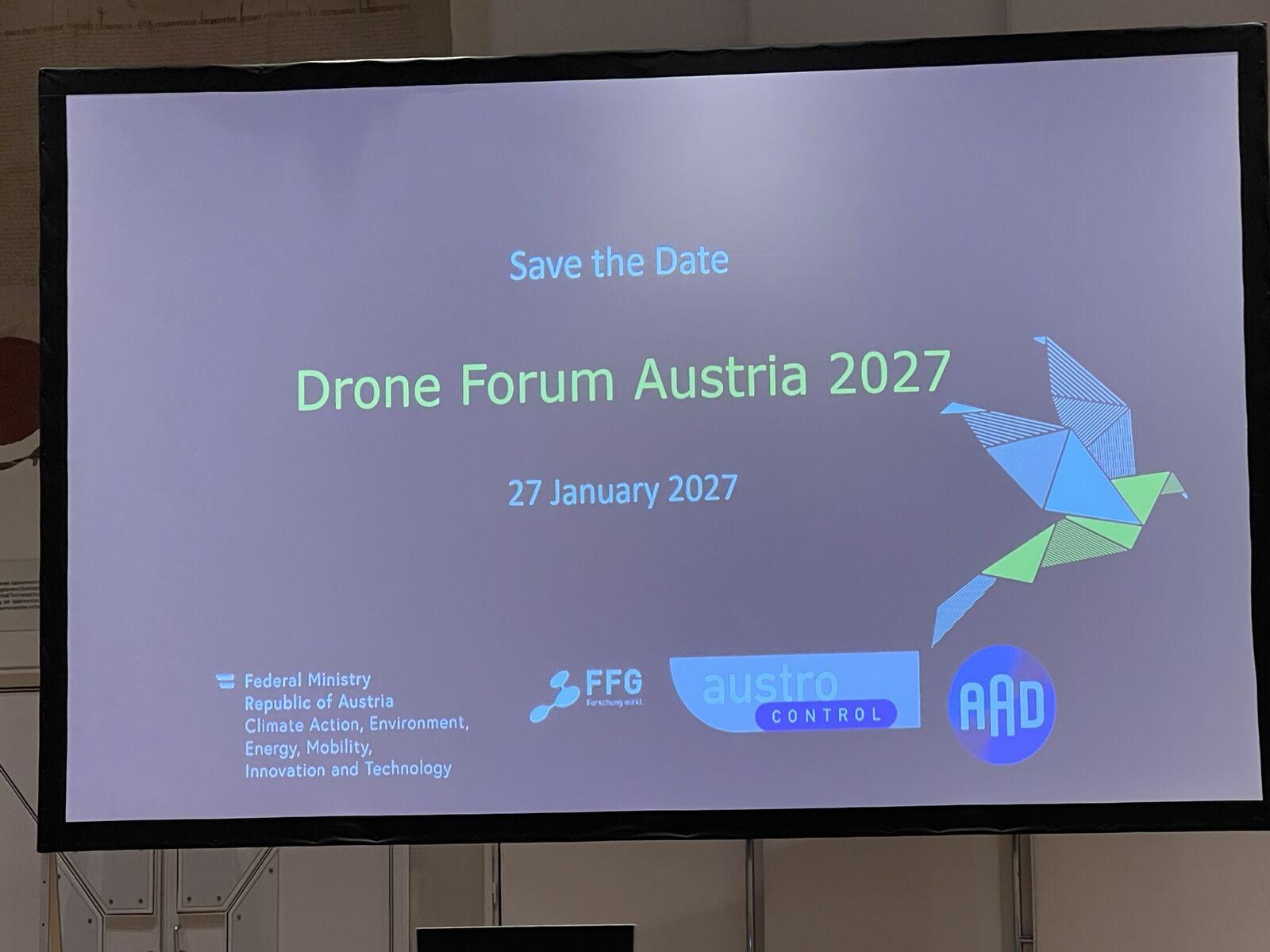
Dates for 2027: Drone Forum Austria on 27 January; CRIAQ RDV Forum in Montréal on 24 February; Aviation Forum Austria on 18 March; Take Off International Call in Q2; funding decisions for the 2026 call in Q3; Take Off Insights 2027 in Q4.
Five things founders should do now
- If you hold an FFG or Horizon Europe grant, apply to Expedition Zukunft #SERVICES. It is fast, fully funded and aimed at exactly the commercial questions technical teams postpone.
- Write your Take Off proposal for the new gate. Quality and feasibility must clear 40 points before impact counts, and sustainability can knock you out.
- Run a freedom-to-operate check early. DiMiTe's patent finding turned into an OEM conversation because it came early.
- Look for the adjacent market. Inspection drones went to oil and gas; combustion AI may go to industrial burners first.
- Use international frameworks. CRIAQ's model and the Take Off International Call make transatlantic consortia realistic without cross-border money flows.
Every presentation, one article each
Keynote
- CRIAQ's playbook: collaborative R&D in Québec (coming on 16 Nov), Guillaume Côté, CRIAQ
UAS & Testing
- INCONTROL-RL: fail-safe drone flight control (coming on 17 Nov), Bernhard Lutzer, TTTech
- All-weather Drone: rain, snow and ice (coming on 18 Nov), David Kozomara, AIIS
- LAUDENT: laser ultrasound by drone (coming on 19 Nov), Bernhard Reitinger, RECENDT
- JARVIS4Pre: RL for composite draping (coming on 20 Nov), Ulrich Kuenzer, Alpex Technologies
- AeroDOM: distortion-optimised titanium machining (coming on 21 Nov), Gernot Mauthner, TU Wien
AI, Cyber & Operations
- ARIADNE: AI tools for aero-engine design (coming on 22 Nov), Marian Staggl, TU Graz
- CyMoDACs: securing LDACS (coming on 23 Nov), Holger Flühr, FH JOANNEUM
- DiMiTe: a motor inside the fan gearbox (coming on 24 Nov), Christopher Gross, ADT
- AirWorld - Door2Door: seamless air-rail travel (coming on 25 Nov), Bernhard Rüger, netwiss
- WeCAP TMA: RL for approach complexity (coming on 26 Nov), Andreas Janecek, Robimo
Funding Insights
- Take Off Call 2026, Vera Eichberger, FFG
- Expedition Zukunft #SERVICES (coming on 15 Nov), Philipp Aiginger-Evangelisti, FFG
Safety, Training & ATM
- EmPACT: AI for competency-based pilot training (coming on 27 Nov), Christian Thomay, Research Studios Austria
- SAFER: remote-tower AI without labels (coming on 28 Nov), Maximilian Hantsch, Frequentis
- 3D-ICESIM: icing simulation in 3D (coming on 29 Nov), Thomas Neubauer, FH JOANNEUM
- LABELO: laser-structured anti-ice surfaces (coming on 30 Nov), Roland Fürbacher, TU Wien
Propulsion, UAM & Materials
- crystAIr: predicting combustion instabilities (coming on 1 Dec), Fabrice Giuliani, Combustion Bay One
- im.FLUGE: trust in automated air taxis (coming on 2 Dec), Setareh Zafari, AIT
- GREEN-by-GEARS: the geared turbofan's next steps (coming on 3 Dec), Martin Berens, TU Wien
- LHYTAMAN: a liquid hydrogen test platform (coming on 4 Dec), Andreas Strohmer, TEST-FUCHS
Thanks to the FFG and BMIMI for an excellent event, and to every presenter for sharing honest results, including what didn't work. Swiss Aerospace Ventures helps aerospace founders move from validation to funding. If one of these projects overlaps with what you are building, get in touch.
People and organisations
- Karin Tausz, CEO, FFG
- Vera Eichberger, Moderator, Take Off programme, FFG
- Sophie Hoffmann, Closing remarks, BMIMI
- Guillaume Côté, President & CEO, keynote, CRIAQ
Organisations: FFG - Austrian Research Promotion Agency, BMIMI - Federal Ministry for Innovation, Mobility and Infrastructure, CRIAQ
Sources
- Take Off Insights 2026 event page and agenda (FFG)
- Presentations at Take Off Insights 2026, Vienna, 12 November 2026
- Take Off Ausschreibung 2026 (FFG)
- Expedition Zukunft #SERVICES (FFG)
- Further sources are listed in each dedicated article.