All-weather Drone: what rain, snow and ice actually do to a multicopter
Take Off Insights 2026 · Session "UAS & Testing" · David Kozomara, Austrian Institute for Icing Sciences (AIIS)
Drone demand keeps growing, but most professional multicopters still stay on the ground when the weather turns. The reason is simple: nobody really knew how rain, snow and especially icing affect them, and the regulations had nothing to say about it.
At a glance
| Consortium | AIIS (lead), AeroTex, Austro Control, BRIMATECH, Eologix Sensor Technology, FH JOANNEUM, RTA Rail Tec Arsenal, ATT advanced thermal technologies, AIRlabs Austria, Meteomatics |
| Advisory board | EASA, FAA, Airbus |
| Scope | Multicopters up to 25 kg MTOW |
The objectives
- Understand weather effects on multicopters up to 25 kg.
- Detect critical conditions.
- Develop anti- and de-icing solutions.
- Recommend safe operating practices.
What they found
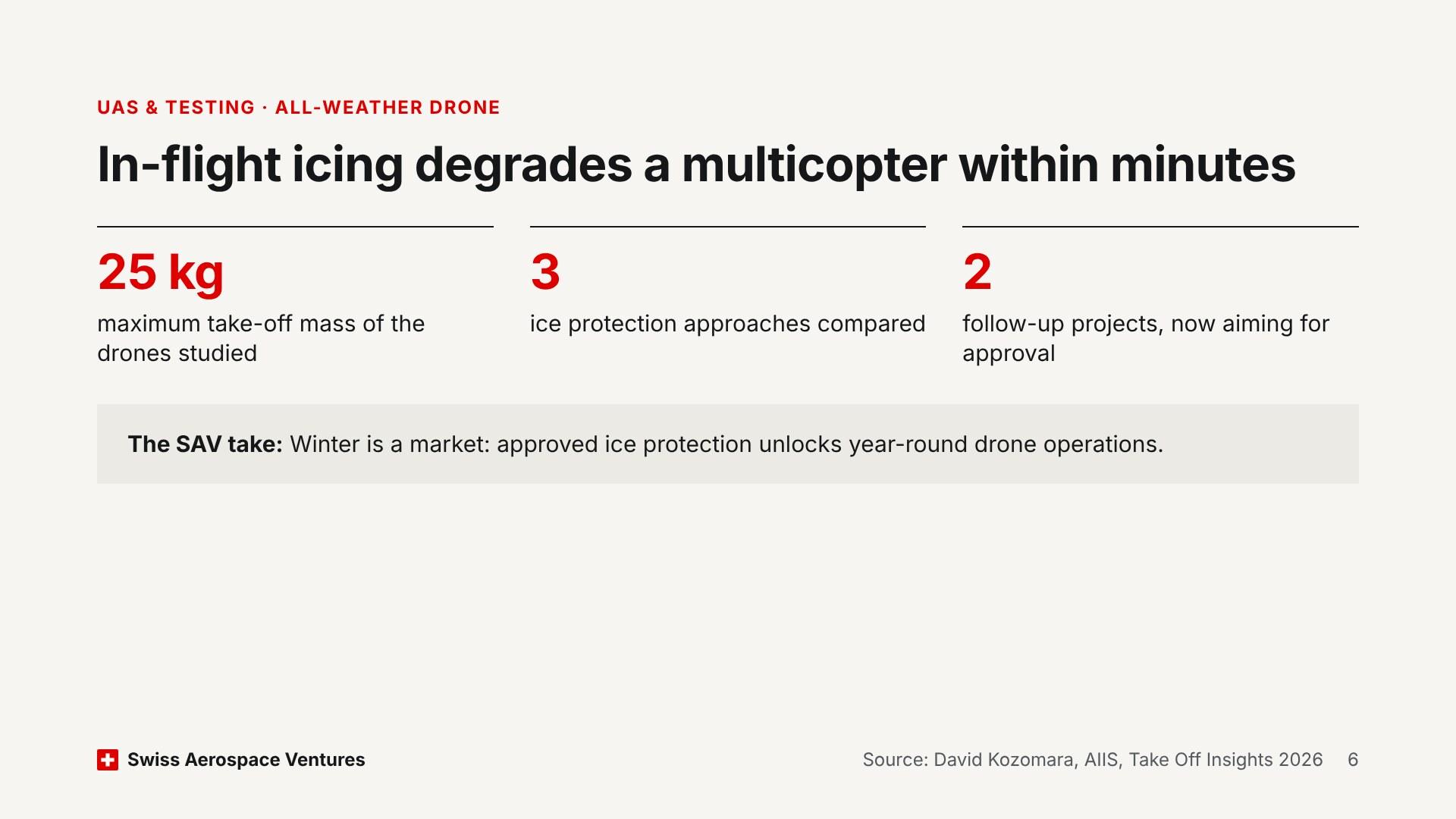
Climatic wind-tunnel tests at RTA in Vienna on propellers and complete multicopters produced reference data on performance loss. The headline finding: in-flight icing causes severe degradation within minutes.
The team then compared three protection approaches: hydrophobic and icephobic coatings, an electrothermal heater foil and a fluid-based ice protection system. The fluid-based system was the most promising, and it needs very little power, which matters on a battery-powered aircraft. A patent application has been filed, and results were presented at the SAE Icing Conference, DLRK and AIAA Aviation.
What came next
All-weather Drone has already spawned two follow-ups:
- IceDrone (2024-2026): cold-weather drones for emergency and rescue services, including in-flight icing.
- IceDrone 2 (2026-2029): taking the fluid-based system to market readiness and approval, integrated into commercial UAS up to 25 kg.
Context
The FFG project database describes IceDrone 2 as a 30-month project with around €717,000 in funding. It splits the drone ice protection system into an ice-detection module that combines several independent means of detection, and a de-icing module that sprays a biodegradable fluid onto the propellers. The aim is evidence that supports certification and operational approval in EASA's Specific category. EASA is also involved as technical advisor to the related ICESDrone project led by AIIS.
Related: 3D-ICESIM: simulating aircraft icing in 3D (coming on 29 Nov) · LABELO: laser-structured anti-ice surfaces (coming on 30 Nov)
Back to the overview: Take Off Insights 2026
People and organisations
- David Kozomara, Speaker, Austrian Institute for Icing Sciences (AIIS)
Organisations: AIIS - Austrian Institute for Icing Sciences, AeroTex, Austro Control, BRIMATECH, Eologix Sensor Technology, FH JOANNEUM, Rail Tec Arsenal (RTA), ATT advanced thermal technologies, AIRlabs Austria, Meteomatics
Sources
- Talk and slides by David Kozomara, Take Off Insights 2026, Vienna, 12 November 2026
- IceDrone 2 (FFG project database)
- ICESDrone (EASA research projects)