LAUDENT: flying a laser ultrasound lab to the aircraft
Take Off Insights 2026 · Session "UAS & Testing" · Bernhard Reitinger, RECENDT
Reitinger opened with a reminder that good projects often start as playful ideas. Lasers plus drones sounds like a joke until you look at the economics of aircraft maintenance.
At a glance
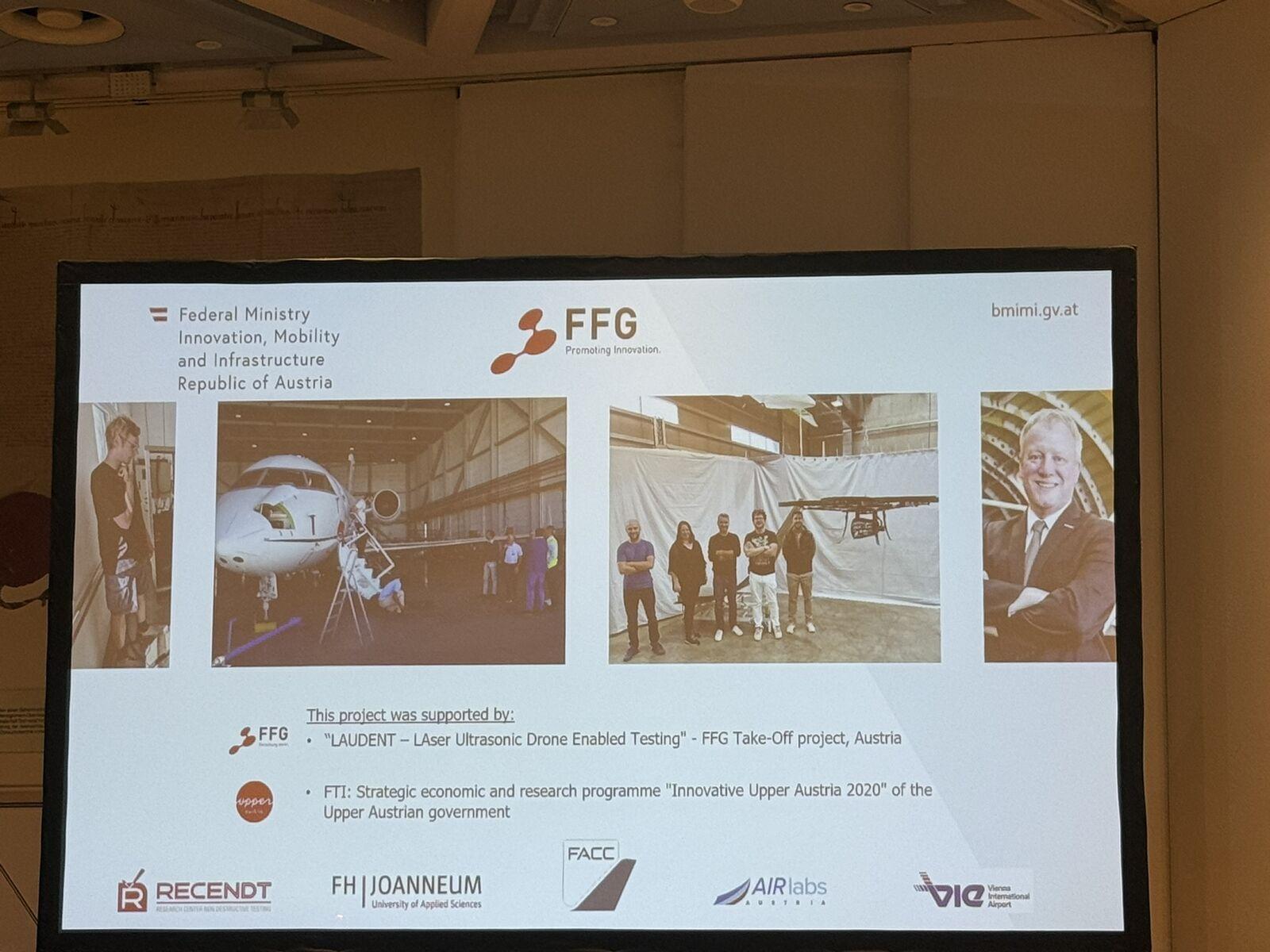
| Consortium | RECENDT (lead), FH JOANNEUM, FACC, AIRlabs Austria, Vienna International Airport |
| Funding | FFG Take Off, plus Upper Austria's "Innovative Upper Austria 2020" programme |
| Idea | Non-contact laser ultrasound (LUS) carried by a drone to inspect composite airframes |
Why inspection is a big deal
The slides put numbers on it: grounding an aircraft costs roughly USD 4,000-10,000 per hour; each aircraft sees at least one scheduled and typically three to four unscheduled inspections per year; global MRO spending is projected at about USD 120 billion per year by 2031.
Camera-based drone inspection already exists and finds large defects in aluminium. What it cannot see is barely visible impact damage (BVID) inside carbon-fibre composites, which make up as much as half of the structural weight of modern widebodies. Ultrasound C-scans reveal that damage layer by layer, but traditionally need contact, climbing gear and a hangar.
The architecture
LAUDENT's answer is a tethered drone. The heavy laser sources stay in a ground station; a multicore fibre carries the generation laser, further fibres carry the detection signal, and the tether also supplies power and data. A side benefit: a connected drone is easier to get approved for flights in or near an airport.
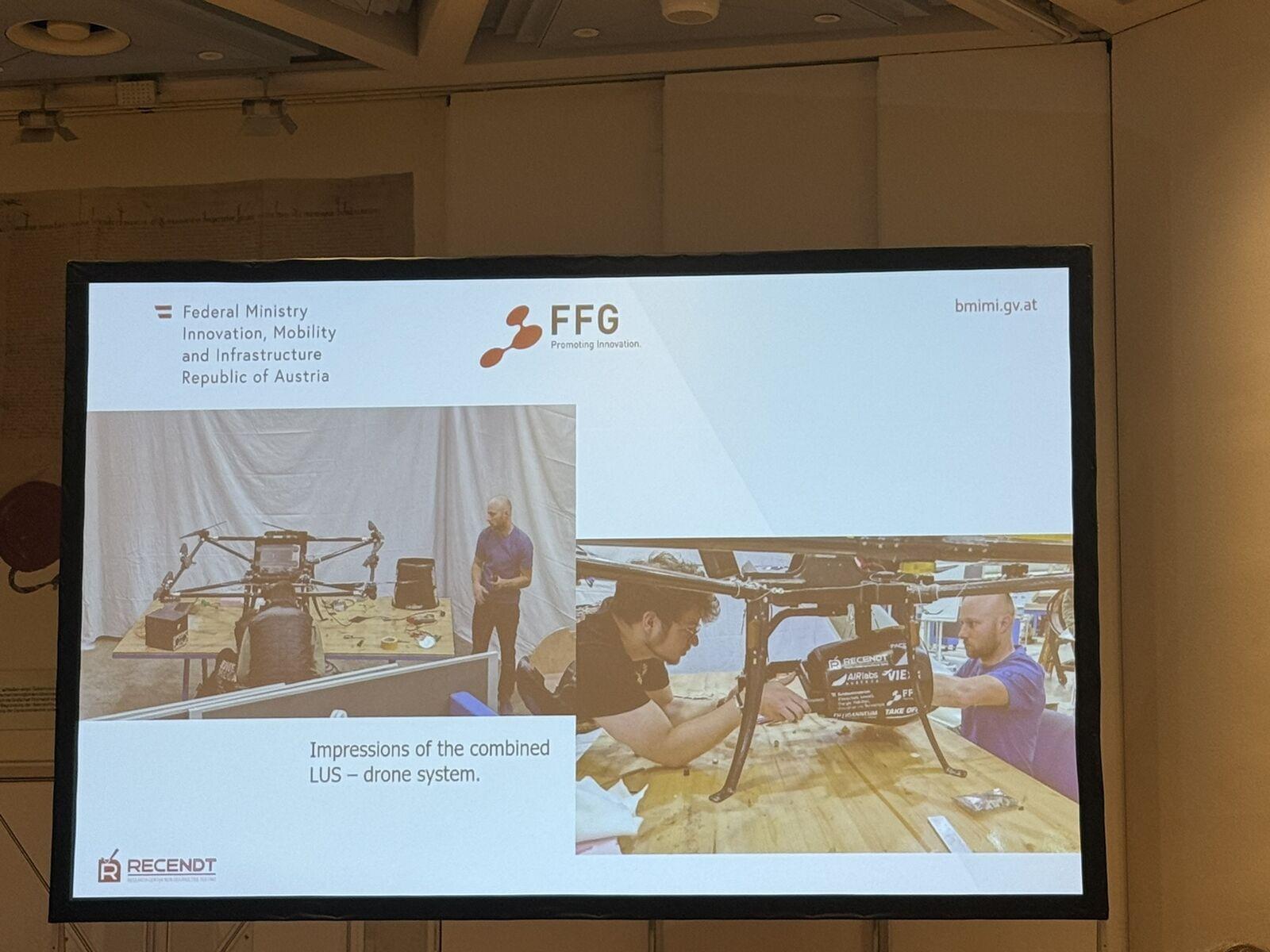
- Drone based on the self-built "Hilicopter": 25 kg MTOW, about 1 m × 1 m × 60 cm, cascaded flight control.
- Heavy-duty gimbal (max 7.5 kg) in a lightweight CFRP housing.
- Probe with 1.5 m stand-off distance and 200 mm depth of focus, combining generation and detection optics, a 3D camera and a distance sensor. Projected artificial features let the system reconstruct where each measurement was taken.
Status
Delivered: the combined LUS-drone system, the long stand-off probe, the fibre connection, position reconstruction and the large-payload drone with gimbal. Still open: stabilising the coupled system against vibration, and position reconstruction in bright light.
The project was presented at the 7th International Symposium on Laser Ultrasonics and Advanced Sensing in Nanjing, where it drew attention for inspecting aircraft, large buildings and ships. That led to negotiations with a leading oil and gas multinational and an ongoing international development project.
Back to the overview: Take Off Insights 2026
People and organisations
- Bernhard Reitinger, Speaker, RECENDT
Organisations: RECENDT, FH JOANNEUM, FACC, AIRlabs Austria, Vienna International Airport
Sources
- Talk and slides by Bernhard Reitinger, Take Off Insights 2026, Vienna, 12 November 2026 (MRO figures as cited on the slides: Oliver Wyman, Alton Aviation, Statista)