AirWorld - Door2Door: the bottleneck to air-rail travel isn't technology
Take Off Insights 2026 · Session "AI, Cyber & Operations" · Bernhard Rüger, netwiss OG
Rail is the obvious sustainable feeder for long-haul flights, yet most travellers still drive, take a taxi or book a short feeder flight. AirWorld - Door2Door asked why, and what it would take to make door-to-door travel feel as seamless as the flight itself.
At a glance
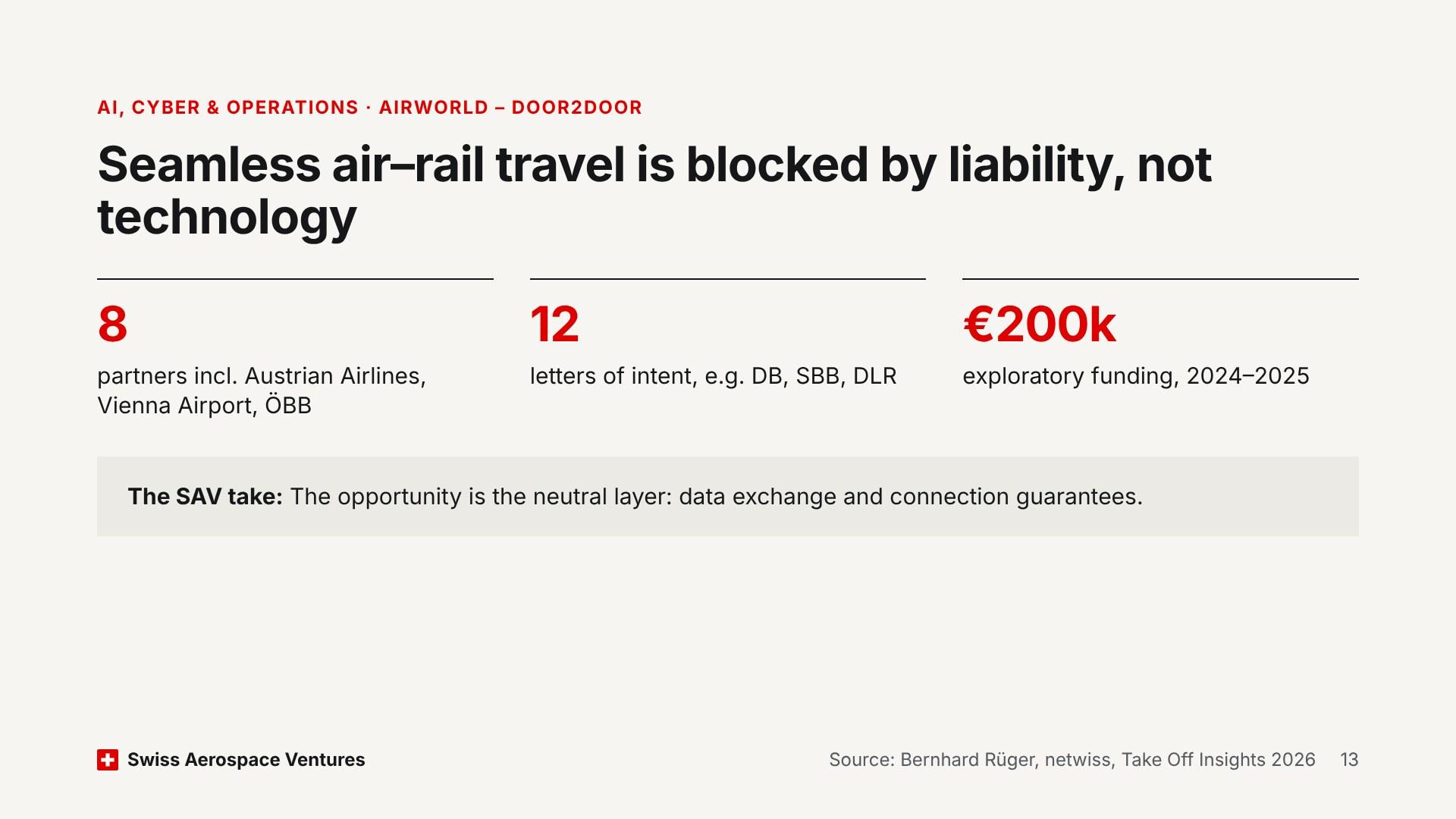
| Consortium | netwiss (coordinator), TU Wien Institute of Transportation, FH JOANNEUM, N+P Experience Design, Austrian Airlines, Vienna Airport, ÖBB-Personenverkehr, Hilfsgemeinschaft der Blinden und Sehschwachen |
| Support | Letters of intent from 12 organisations, including DB Fernverkehr, SBB, DLR, Innsbruck Airport, Airportr and Aston University |
| Programme | FFG Take Off exploratory project, call 2023; July 2024 - August 2025; €199,997 funding |
Why travellers avoid the train
Desk research, an international benchmark, expert interviews and four stakeholder workshops produced a clear list of pain points:
- Every leg is planned, booked and paid separately.
- Information gaps about delays and alternatives.
- Luggage has to be handled at every change.
- Stressful orientation at interchanges, with little assistance for passengers with reduced mobility.
- Too many apps and no single point of contact.
The concepts
Three families of solutions emerged: luggage logistics (drop-off at stations, post offices or petrol stations; a smart luggage rack; autonomous door-to-door luggage service), a digital companion (one-stop shop, AR/VR travel assistant, predictive planning) and system integration (a connection guarantee based on real-time tracking; AI-supported disruption management). A technology check showed that IoT, RPA, AI, NLP and blockchain make most concepts feasible; the critical issues are data protection, system integration and scalability.
The smart luggage rack stands out. Luggage is checked in digitally during the train ride and dropped into a rack in the low-floor area of the rail car. At the airport, the rack moves automatically out of the train and into the baggage sorting system. Hands-free from seat to gate, with no extra staff on either side.
The connection guarantee uses real-time tracking to prove a delay automatically; an airline or insurer interface defines the latest acceptable departure; missed connections trigger rebooking and compensation as in air travel.
The key finding
The bottleneck is not technology, but responsibilities, liability and data sharing between operators.
The project produced two peer-reviewed papers with three more in preparation, presented at CETRA 2026 and RAILCON '26. Next steps include follow-up R&D on automated luggage handling on trains and end-to-end mobility support. Prerequisites: common interface standards, legally robust data models and new cooperation between public transport, rail, airports and mobility providers.
Related: im.FLUGE: designing trust into urban air mobility (coming on 2 Dec)
Back to the overview: Take Off Insights 2026
People and organisations
- Bernhard Rüger, Speaker, netwiss
Organisations: netwiss, TU Wien, FH JOANNEUM, N+P Experience Design, Austrian Airlines, Vienna International Airport, ÖBB, Hilfsgemeinschaft der Blinden und Sehschwachen Österreichs
Sources
- Talk and slides by Bernhard Rüger, Take Off Insights 2026, Vienna, 12 November 2026