WeCAP TMA: why a perfect AI air traffic controller is the wrong goal
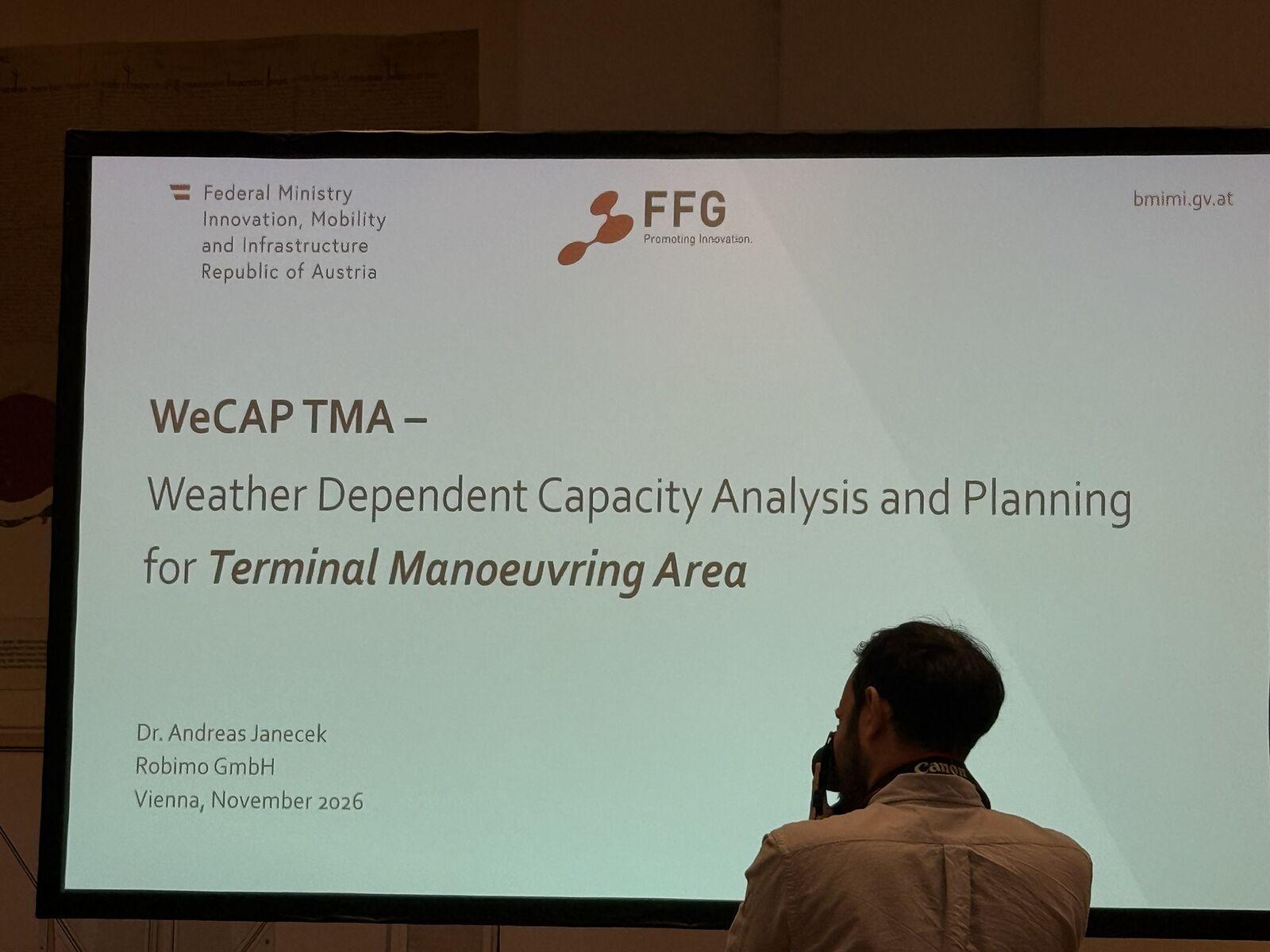
Take Off Insights 2026 · Session "AI, Cyber & Operations" · Dr. Andreas Janecek, Robimo GmbH
Arrival managers tell controllers in which order aircraft should land. What they do not show is how complex the traffic situation is, which means capacity planning, especially when bad weather hits, remains a matter of experience and gut feeling.
At a glance
| Consortium | Robimo GmbH (Vienna SME; generative and agentic AI, ML, reinforcement learning, 3D/VR/AR), Austro Control (Austria's air navigation service provider, MET Development & Innovation) |
| Idea | Use reinforcement learning to generate realistic approach traffic and measure terminal-area complexity |
How it works
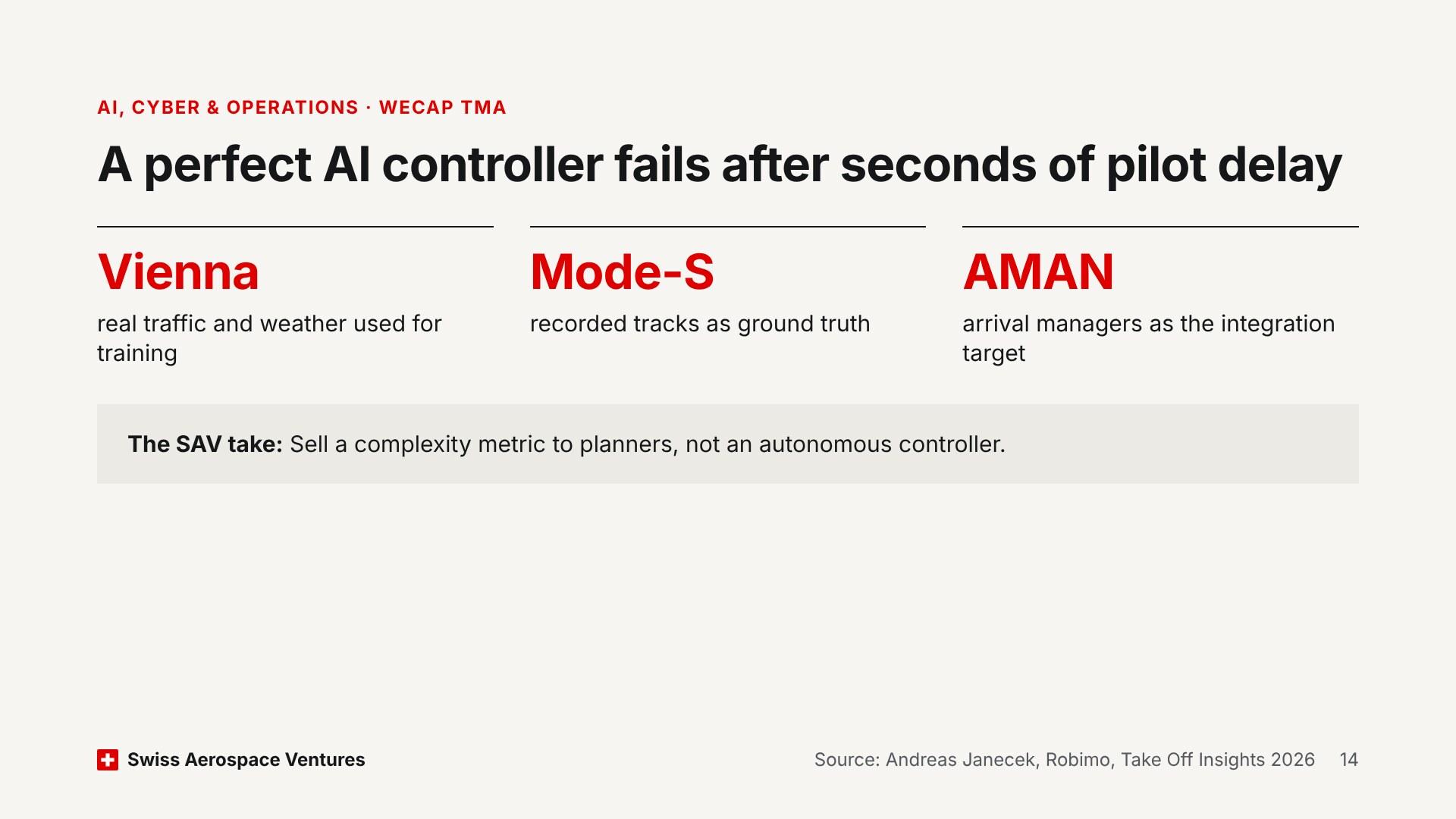
An RL controller agent was trained in a terminal-area simulation on large amounts of real Vienna traffic and weather data: flight plans, wind and weather data, and ATC rules and procedures, with recorded Mode-S tracks as ground truth. Expert knowledge from ATC was used for rules and validation. The output is a set of simulated approach trajectories, from which task complexity under given traffic and weather can be derived as decision support.
The interesting result
Janecek's most memorable point: an RL agent can "solve" almost any approach scenario, with perfect spacing, maximum throughput and every rule respected. But such a solution would hardly survive reality. A few seconds' delay between an instruction and the pilot's reaction, and the plan has to be recalculated. The goal therefore shifted from optimal control to realistic behaviour that reflects how humans actually fly and control.
How it's used
- Austro Control gains an objective measure of traffic and weather complexity for flow, sector and staff planning. RL results can be viewed in TrackAir, ACG's in-house AMAN/DMAN prototype.
- Robimo has built RL know-how for air traffic management (simulation, reward design, training) and sees a new business field, for example extending arrival managers.
Next steps: drop the game engine for faster training and higher accuracy; add departures, 3D climb and descent, holdings and runway changes; feed in grid-based wind and visibility data; and integrate the complexity indicator into AMAN/DMAN systems through a follow-up R&D project.
Related: SAFER: unsupervised AI for remote towers (coming on 28 Nov) · CyMoDACs: securing LDACS
Back to the overview: Take Off Insights 2026
People and organisations
- Andreas Janecek, Speaker, Robimo
Organisations: Robimo, Austro Control
Sources
- Talk and slides by Dr. Andreas Janecek, Take Off Insights 2026, Vienna, 12 November 2026