DiMiTe: putting an electric motor inside the geared turbofan's gearbox
Take Off Insights 2026 · Session "AI, Cyber & Operations" · Christopher Gross, Advanced Drivetrain Technologies GmbH (ADT)
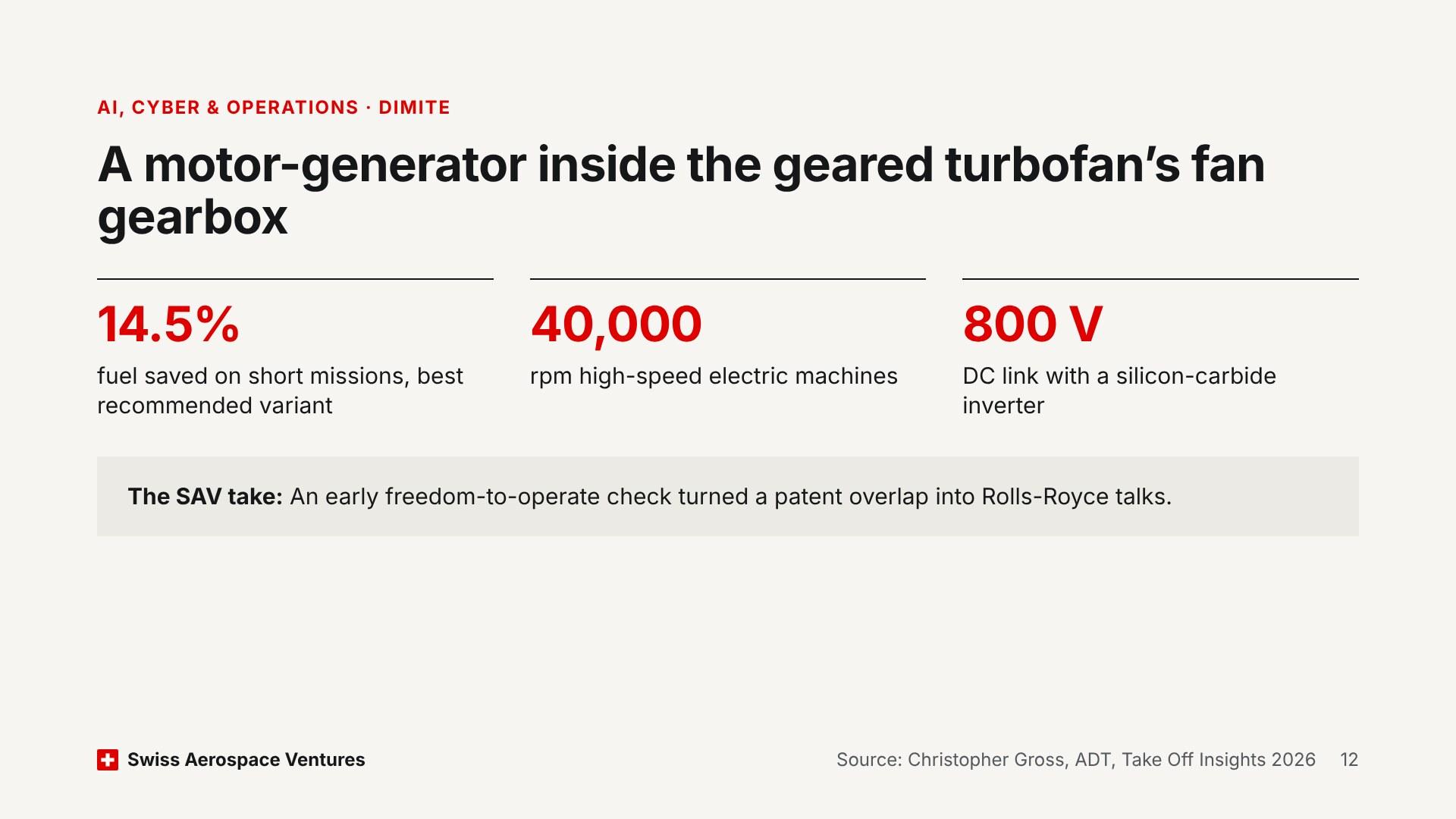
Most hybrid-electric engine concepts bolt motor-generators onto the engine's shafts. DiMiTe (Distributed Microhybrid Turbofan Engine) looked at a different location: inside the planetary gearbox that drives the fan of a geared turbofan.
At a glance
| Consortium | ADT (lead: system architecture, gearbox integration, CAD, energy modelling), AIT Austrian Institute of Technology (electric machine, power electronics, inverter), LKR Leichtmetallkompetenzzentrum Ranshofen (lightweight design, materials, exploitation) |
| Type | FFG exploratory project (Sondierung) |
| Reference | Airbus A320neo with Pratt & Whitney PW1100G |
The concept
The team studied four operating strategies: more-electric aircraft, electric taxi, take-off boost and engine downsizing. Their design uses:
- High-speed permanent-magnet machines running at 40,000 rpm, each with an additional planetary stage (ratio 4).
- An 800 V DC link with a three-level SiC inverter.
- A module under 500 mm long weighing about 300 kg, roughly 10% of the engine.
One honest finding: starting the core engine through the proposed gearbox coupling was not feasible.
Mission results
Four hybridisation variants were evaluated against the A320neo on 900 km and 2,000 km missions. All variants burned less fuel than the reference, with the biggest gains on short missions, because battery weight hurts more on long ones. Emissions near airports drop too.
| Variant | Fuel benefit, short mission | Fuel benefit, long mission | Complexity | Recommended |
|---|---|---|---|---|
| I | 3% | 4% | Low | Yes |
| II | 8% | 7.5% | High | No |
| III | 14.5% | 8.5% | High | Yes |
| IV | 16% | 8.5% | Very high | No |
Variant III delivered the lowest total energy demand on both missions. Variant IV came with significant range and payload penalties.
From study to industry
A freedom-to-operate review found overlap with a Rolls-Royce patent; the team adapted its IP approach and opened contact with Rolls-Royce. Discussions with European engine OEMs and tier-1 suppliers are under way, and the know-how is already flowing into a European-funded project that started the week before the event.
Context
The large-engine world is moving in the same direction from another angle. In the Clean Aviation SWITCH project, Pratt & Whitney, Collins Aerospace, MTU, GKN and Airbus are building a hybrid-electric GTF demonstrator with two megawatt-class motor-generators on the engine's low and high spools. Collins began powertrain testing at its Grid facility in Rockford, Illinois, in March 2026.
Related: GREEN-by-GEARS: decarbonisation through geared turbofans (coming on 3 Dec)
Back to the overview: Take Off Insights 2026
People and organisations
- Christopher Gross, Speaker, Advanced Drivetrain Technologies
Organisations: Advanced Drivetrain Technologies, AIT Austrian Institute of Technology, LKR Leichtmetallkompetenzzentrum Ranshofen
Sources
- Talk and slides by Christopher Gross, Take Off Insights 2026, Vienna, 12 November 2026
- Collins begins powertrain testing for Clean Aviation SWITCH (RTX)
- P&W completes preliminary design review of hybrid-electric GTF (Defense Mirror)