EmPACT: eye tracking and AI for competency-based pilot training
Take Off Insights 2026 · Session "Safety, Training & ATM" · Mag. Dr. Christian Thomay, Research Studios Austria Forschungsgesellschaft
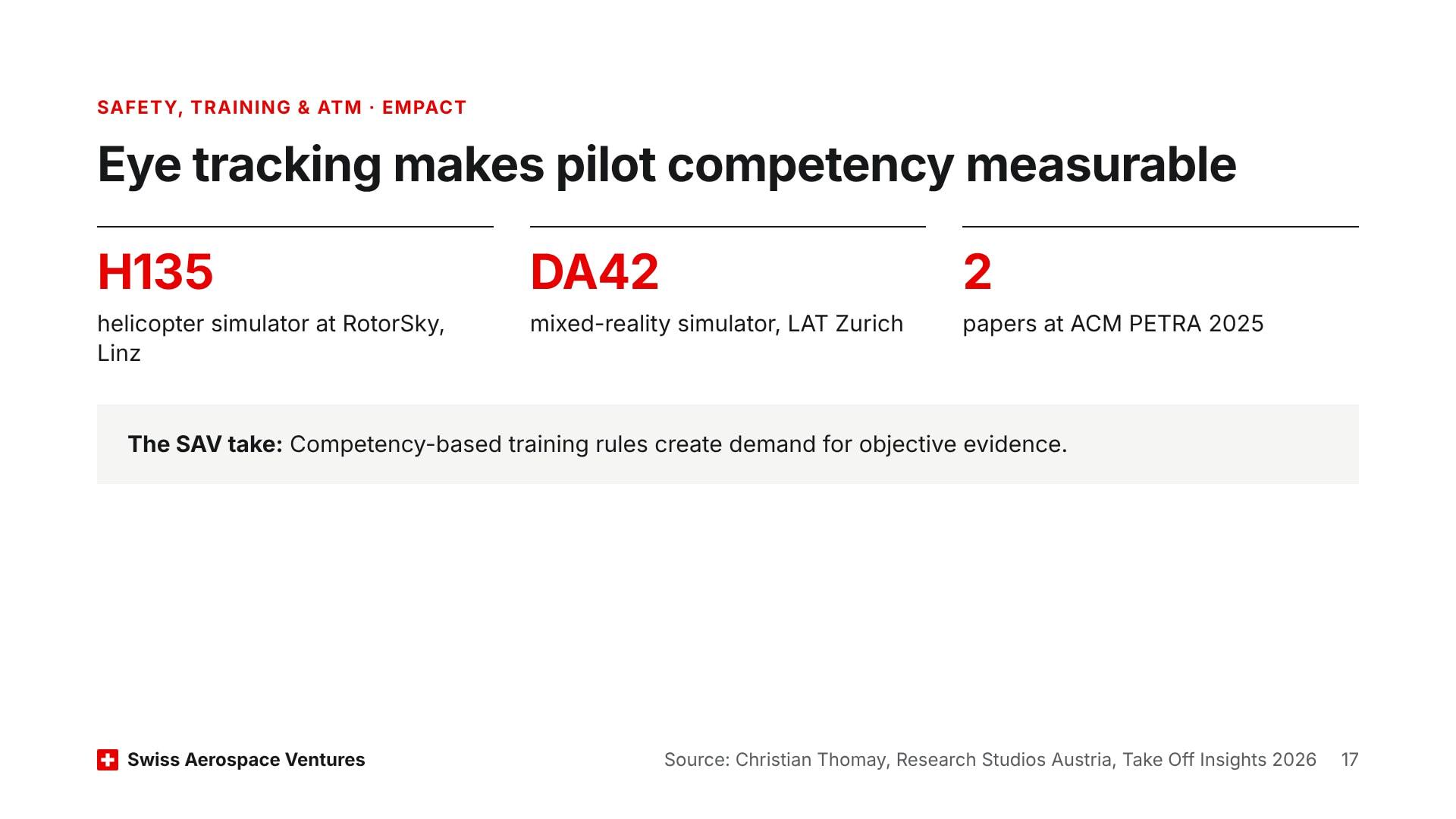
Pilot training is moving from counting hours and ticking off manoeuvres towards competency-based training and assessment (CBTA): observing how a pilot actually performs across defined competencies. That raises a practical problem: how do you assess competencies objectively and consistently? EmPACT's answer is sensors and AI in the simulator.
At a glance
| Lead | Research Studios Austria Forschungsgesellschaft |
| Training partners | RotorSky (helicopter training, Linz), Lufthansa Aviation Training, plus technology partners |
| Research environments | Airbus H135 FTD 3 at RotorSky in Linz; NOVASIM DA42 mixed-reality simulator at the LAT Training Center Zurich |
The aim
EmPACT works in four steps: (1) assess behaviour and competence through eye tracking, activity analysis and cognitive load; (2) model the pilot's state and competencies; (3) detect errors and shortcomings; (4) deploy automated assistance and feedback.
Results
- Advanced eye-tracking analysis and cognitive-load measurement in mixed reality: where a pilot looks, and how loaded they are, during normal and abnormal procedures.
- Automatic procedure detection and feedback: events are recognised from simulator data, for example labels for an engine failure and emergency landing, so instructors get structured debriefing material without manual annotation.
Two papers were published at the ACM PETRA 2025 conference, on automated competency assessment based on flight performance and visual attention, and on pilots' visual behaviour and cognitive load during engine failures with an emergency-landing assistance system in mixed reality.
What's next
The FlightAnalyser tool has become the project's central research and debriefing solution, with possible integration into simulation products. Next steps: integration with more simulation devices and training management systems, and hybrid AI-based CBTA analysis. Follow-ups include MAVerICS (Multi Aircraft Versatile Integrated CBTA Simulation) and integrating FlightAnalyser on mixed-reality simulators for DLR.
Context
CBTA is spreading across aviation training. EASA is developing ab-initio CBTA through a dedicated rulemaking project, EASA and EUROCONTROL held a joint workshop on air traffic controller CBTA for national authorities in late October 2026, and major providers such as CAE began rolling CBTA principles into recurrent training in January 2026.
Back to the overview: Take Off Insights 2026
People and organisations
- Christian Thomay, Speaker, Research Studios Austria
Organisations: Research Studios Austria, RotorSky, Lufthansa Aviation Training
Sources
- Talk and slides by Christian Thomay, Take Off Insights 2026, Vienna, 12 November 2026
- CBTA: enhancing safety outcomes (Halldale)
- EASA and EUROCONTROL joint ATCO CBTA workshop (EUROCONTROL)
- CAE implements CBTA model in business aviation recurrent training (AIN)