AeroDOM: predicting and correcting distortion when milling titanium aerospace parts
Take Off Insights 2026 · Session "UAS & Testing" · Gernot Mauthner, TU Wien, Institute of Production Engineering and Photonic Technologies (IFT)
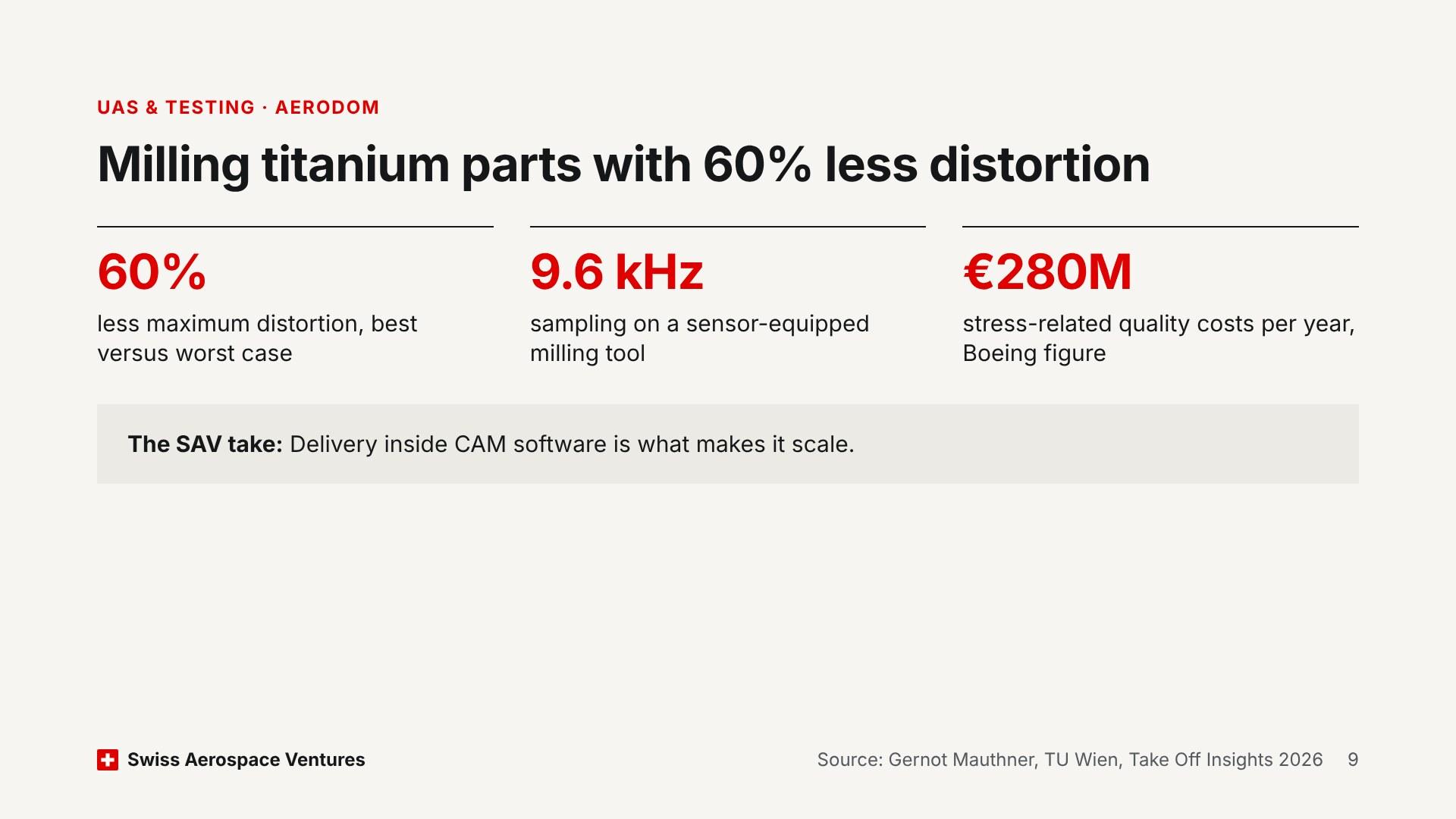
When a forged titanium part is milled, the material removed releases residual stresses and the part warps. It is one of the most expensive quality problems in aerospace machining. Mauthner cited a Boeing figure of around €280 million in stress-related quality costs per year.
At a glance
| Consortium | TU Wien IFT (lead), Materials Center Leoben (MCL), voestalpine BÖHLER Aerospace, ModuleWorks (Germany) |
| Material | Ti-6Al-4V forgings |
| Goal | An algorithm that predicts and corrects workpiece distortion during milling |
Three results
1. Distortion shows up in the cutting data. A sensor-equipped milling tool recording cutting forces at 9.6 kHz, combined with feature-based CAD-CAM-CNC-CMM data integration, can indicate over- and under-cutting.
2. The simulation chain works qualitatively. MCL characterised the material and modelled residual stresses in the forging; IFT simulated material removal and connected it to CAM.
3. Machining rules validated. Comparing best and worst machining strategies in the IFT lab, the identified rules improved maximum distortion by 60%.
Where it goes
Two peer-reviewed papers and five theses are finished. voestalpine has taken over the data-collection system and is evaluating the FEA approach in its engineering workflow. ModuleWorks, whose CAM components sit inside many commercial CAM systems, is prototyping CAM-integrated simulation.
Back to the overview: Take Off Insights 2026
People and organisations
- Gernot Mauthner, Speaker, TU Wien IFT
Organisations: TU Wien, Materials Center Leoben, voestalpine BÖHLER Aerospace, ModuleWorks
Sources
- Talk and slides by Gernot Mauthner, Take Off Insights 2026, Vienna, 12 November 2026